

Why cat hydration matters more than you think — and what to do about it

Ask most cat owners how much water their cat drinks and you will get a vague answer. A bit. Not much. She prefers the tap. The truth is that most cats are quietly, chronically under-hydrated — and the consequences over a lifetime are far more serious than most people realise. Kidney disease is one of the most common conditions in older cats. It is also one of the most preventable. And the single most impactful thing you can do starts with something as simple as where you put the water bowl.

Why cats have a naturally low thirst drive
Cats are obligate carnivores who evolved in arid environments. Their wild ancestors did not drink from ponds — they obtained almost all of their moisture from prey. A mouse is approximately 70% water. The system worked perfectly when cats were eating fresh, moisture-rich animals.
The problem is that most domestic cats are fed predominantly dry food, which contains as little as 10% moisture. Their bodies are still running on ancient programming that says they do not need to drink much. The result is a cat who is quietly, chronically under-hydrated — often for years, without obvious signs — until kidney function begins to decline.
Signs your cat may not be drinking enough
Obvious dehydration in cats is relatively rare — and by the time it is visible, things are already quite serious. The signs to watch for are much more subtle:
🐾 Gums that feel dry, sticky or tacky rather than moist and slippery.
🐾 Concentrated, dark yellow or strong-smelling urine — a well-hydrated cat produces pale, odourless urine.
🐾 Mild lethargy or reduced activity that is hard to explain.
🐾 Reduced appetite, particularly for dry food.
🐾 A coat that looks dull or lacks its usual lustre and shine.
🐾 The skin pinch test — gently pinch the scruff and release. In a well-hydrated cat it springs back immediately. In a dehydrated cat, it returns slowly.
None of these signs are conclusive alone — but if you notice more than one, it is worth looking honestly at your cat's water intake and speaking to your vet.
What we do at The House of Siamese
We feed our girls a combination of high-quality wet food and dry food. The wet food contributes significantly to their daily moisture intake — a cat eating wet food twice a day is getting far more water than one eating only dry kibble, even if they appear to drink similar amounts.
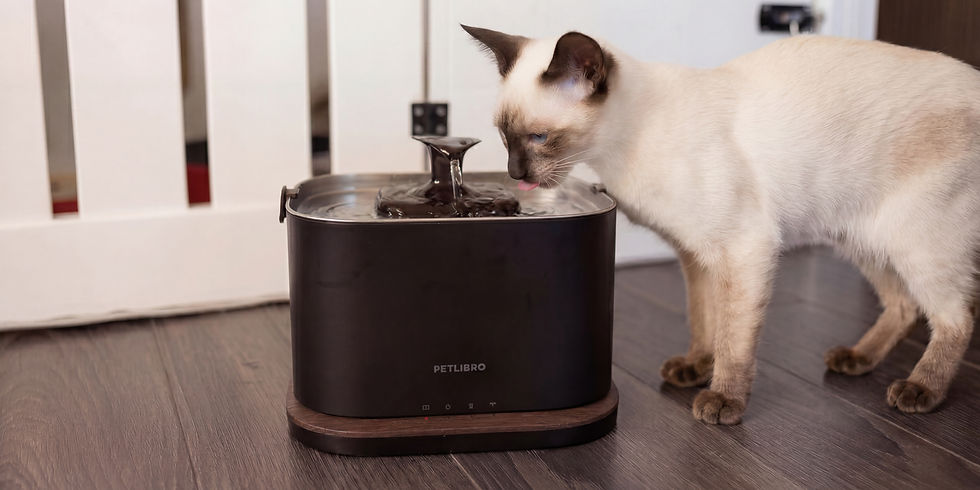
We also use water fountains rather than static bowls. Cats are instinctively drawn to moving water — in the wild, still water is more likely to be stagnant and unsafe. A fountain mimics the movement of fresh water and consistently encourages our girls to drink significantly more.
Practical tips you can start today
🐾 Switch at least one meal a day to wet food — even one wet meal significantly increases daily moisture intake.
🐾 Move water away from food bowls — cats are instinctively reluctant to drink near their food, an evolutionary response to contamination risk.
🐾 Use ceramic or stainless steel — plastic retains odours and can leave an off-putting taste that discourages drinking.
🐾 Change the water daily even if using a filtered fountain — fresh water is always more appealing.
🐾 Try multiple locations — some cats have strong preferences about where they drink.
🐾 Add low-sodium broth occasionally — a splash of warm chicken broth in water is irresistible to many cats.
If you are expecting a Siam-Amor kitten and want advice on setting up at home get in touch directly and we are always happy to help.
How much water should a cat drink per day?
Generally around 50ml per kilogram of body weight per day. A 4kg cat should ideally drink around 200ml daily. Cats on wet food will drink less as they obtain moisture from their food.
Why does my cat prefer drinking from the tap?
This is very common and perfectly explained by feline evolution. Running water signals freshness and safety — in the wild, still water is more likely to be contaminated. A cat who prefers the tap is telling you they are drawn to moving water, which is exactly why a fountain tends to encourage significantly more drinking than a static bowl.
At what age should I introduce a water fountain for a kitten?
From day one is ideal. Kittens introduced to a fountain early tend to use it consistently throughout their lives. If you are expecting a Siam-Amor kitten, they are already accustom to them so we recommend having the fountain set up and running before collection day so it is already part of the environment when they arrive home.
Can hard water affect my cat's health?
Hard water is not generally harmful to cats, though some cats may prefer the taste of filtered water. A good fountain with an active carbon filter — like the Petlibro Dockstream 2 — continuously filters the water, which removes impurities and tends to make it more appealing regardless of water hardness in your area.
How often should I clean a cat water fountain?
We recommend a thorough clean every week, and a filter change as directed by the manufacturer — typically every four to six weeks depending on usage. The Petlibro Dockstream 2 has a straightforward disassembly that makes cleaning quick and easy. Regular cleaning keeps the water fresh and your cat drinking well.
The content is presented in a clear and well-organised way. The information is organised logically and easy to follow. I took notes on some of the points that seemed particularly relevant. It is a good reference point for anyone wanting to explore the topic.
Ours drink from the tap. They hate their bowls... 😂
This literally our boys, constantly drinking from the tap. We never thought of a water fountain. We've just ordered two.